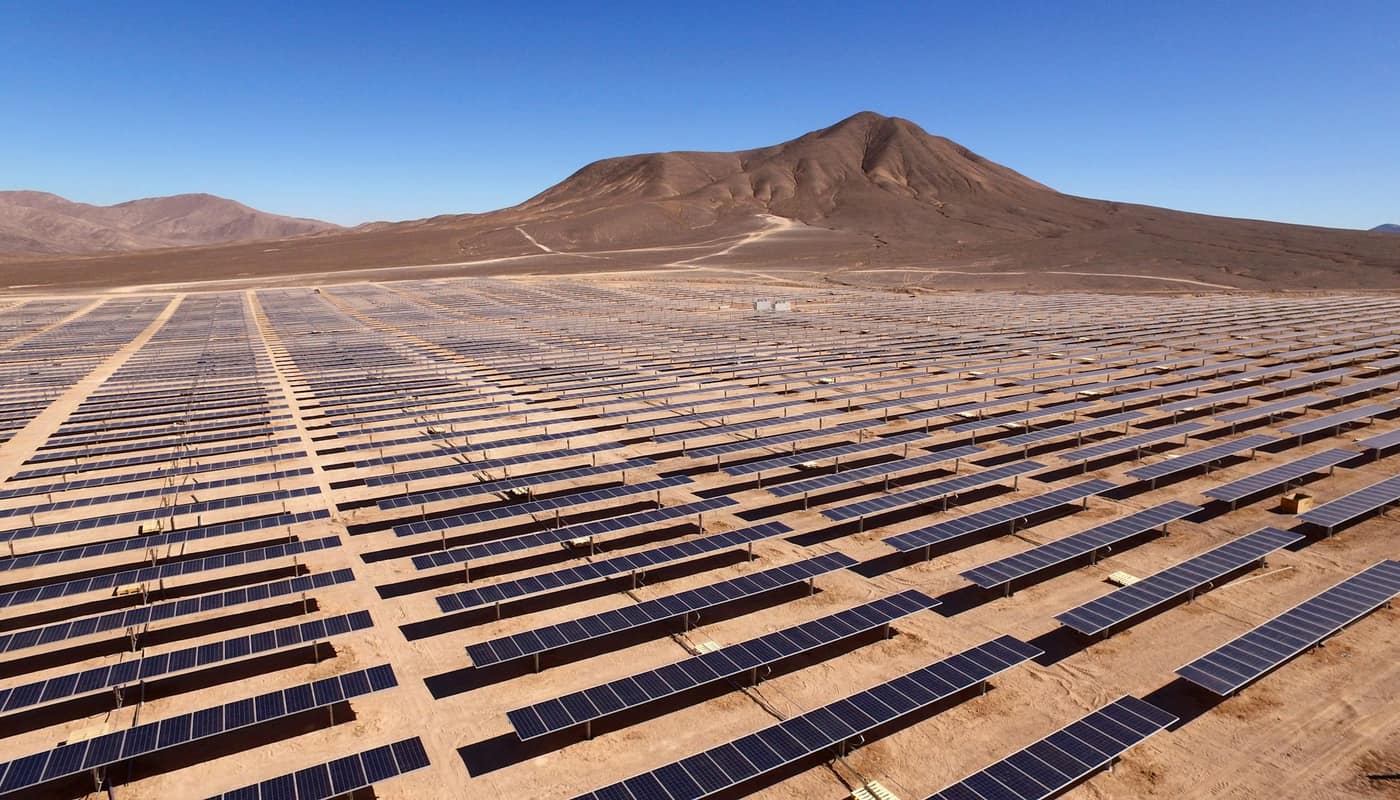
A strip of desert, a clear sky and a lot of space: those are the ingredients of a utility-scale solar farm. The Gulf has all three, and several of the world’s largest plants have been built there. Their numbers attract headlines, but the engineering behind them is just as interesting, because heat, dust and the daily rhythm of sunshine all shape how they operate.
How does a photovoltaic plant work?
A solar photovoltaic, or PV, plant converts sunlight directly into electricity using panels made of semiconductor cells. Light knocks electrons loose in the material, creating a direct current. Panels are wired together in strings, the current is collected and converted to alternating current by inverters, and a transformer raises the voltage so that it can be sent to the grid.
Plants range in size from a few megawatts to more than a gigawatt. A megawatt, abbreviated MW, is a unit of power, and a gigawatt, GW, is a thousand megawatts. Capacity figures indicate the maximum power under standard conditions, not the average output over time, which is lower because the sun does not shine at night and its intensity varies.
What are the examples?
According to published descriptions, Noor Abu Dhabi, in the emirate of Abu Dhabi, has a capacity of about 1.18 gigawatts, uses about 3.2 million panels and began commercial operation in 2019. Reports have described it as the world’s largest standalone solar plant at the time it was commissioned, a claim that depends on how projects are defined and on what has been built since.
In Dubai, the Mohammed bin Rashid Al Maktoum Solar Park is being developed in phases. The original target was a capacity of 5,000 megawatts by 2030. A December 2025 report put current output at about 3,860 megawatts and the projected 2030 total at more than 7,260 megawatts, while another press report cited a projection above 8,000 megawatts. Because sources differ, readers should check the utility’s own announcements for the current figure.
In Abu Dhabi, a project by the clean energy company Masdar and the water and electricity company EWEC has been described in trade press as the world’s largest 24-hour solar and battery project, combining a large solar plant with a large battery system so that power can be delivered through the night. As with other superlatives, it is best to check the developers’ statements for the technical details.
How do heat and dust affect performance?
Counter-intuitively, very hot weather reduces the efficiency of PV panels. Their output falls slightly as the temperature of the cells rises, so a panel in a Gulf summer produces somewhat less per unit of sunlight than the same panel in a cool, clear climate. Engineers respond with panel types that tolerate heat, with mounting that lets air circulate and with plant designs that allow for the reduction.
Dust and sand are an even larger challenge. A film of dust blocks light, and a dust storm can cut output sharply. Operators clean panels regularly, often with automated brushes or waterless robotic systems to save water, and they choose sites and layouts to limit soiling. Cleaning schedules are a significant part of operating costs. Humidity near the coast and salt in the air add corrosion concerns.
What are trackers and bifacial panels?
Many large plants use trackers, motorised mounts that tilt the panels to follow the sun from east to west during the day. They raise the energy collected, at the price of more moving parts and maintenance. Bifacial panels collect light on both sides, including light reflected from the ground, which adds a few percent to output when the ground is bright, as desert sand often is. Designers weigh these options against cost and reliability.
What about solar thermal plants?
An alternative to PV is concentrated solar power, which uses mirrors to focus sunlight and heat a fluid, then makes steam to drive a turbine. A major advantage is that heat can be stored cheaply, for example in molten salt, allowing generation after sunset. Several Gulf and North African projects have used the technology, although PV has become much cheaper and dominates new construction. Some developers combine the two.
Why does storage matter?
Solar output peaks at midday, while electricity demand in the Gulf peaks in the late afternoon and evening, when air conditioning is running and the sun is low. To use solar power to cover that evening demand, energy has to be stored. Large batteries can shift energy by several hours, and projects like the one in Abu Dhabi are designed to do so. Another approach is to shift demand, as district cooling systems do by making chilled water or ice in the daytime and using it later, a technique described in how district cooling keeps Gulf cities cool.
How is solar power sold and financed?
In many Gulf markets, solar plants are built through competitive tenders run by the state utility. Developers bid a price per unit of electricity, usually for a long-term power purchase agreement that guarantees the buyer will take the output for 25 years or so. Because the project is financed on the strength of that contract, banks lend at lower rates, and competitive bidding has driven prices down. Large developers, often partnerships between a national energy company and an international firm, win the contracts, and the plants are owned by special project companies.
Analysts note that tender prices depend on assumptions about land, grid connection, financing costs and sunshine, so a low bid is not automatically a sign of a technical breakthrough. Comparing across countries requires care.
What happens at the end of a plant’s life?
Panels typically have a performance guarantee of 25 to 30 years, with a small loss of output each year. At the end of a plant’s life, panels can be refurbished, replaced or recycled, and developers must plan for the handling of waste. Recycling industries for solar panels are still developing, and regulators in many countries are drawing up rules, so the long-term cost and environmental effects of disposal are an active area of work.
How does solar fit into national strategies?
Governments in the region have set targets for clean energy, and large solar plants support both climate goals and economic diversification. Producers of oil and gas have an incentive to use more renewable power domestically, which can free fossil fuel for export or for industry. They also see renewables, hydrogen and related technologies as sectors in which to build expertise, as part of the broader strategy outlined in how Gulf economies are diversifying beyond oil.
Solar power also links to water: the energy demand of desalination is high, and powering membrane plants with renewable electricity is one way to cut its emissions, as discussed in how Gulf desalination turns seawater into drinking water.
How should readers interpret the numbers?
Check what a figure measures. Capacity in megawatts is not the same as annual energy production in megawatt-hours. Direct-current capacity, measured at the panels, is usually higher than alternating-current capacity, measured at the grid connection. Announced capacity is not operating capacity, and a plan for 2030 is not an achieved figure. Comparisons between plants should use the same measure. Utilities, regulators and the International Energy Agency publish statistics that follow defined conventions, and they are the best starting point.
Sources: Dubai Electricity and Water Authority; Masdar; Energy-Storage.news