A generation ago, few visitors to the Gulf expected to spend an afternoon in a museum. Today, several of the region’s cities have built institutions that rival those of older capitals in ambition. They reflect a shift in how governments think about culture: not as an extra, but as part of education, tourism, national identity and the diversification of the economy.
What are the best-known examples?
Two stand out for their architecture and their reach.
The Museum of Islamic Art in Doha was completed in 2008, according to design and architecture sources. It was designed by the architect I. M. Pei and sits on a man-made island just off the city’s waterfront. Its form is built from stacked, unadorned geometric volumes in pale limestone, and Pei is reported to have drawn on fortress architecture and on the Ibn Tulun Mosque in Cairo. Its collection covers Islamic art from three continents and over many centuries.
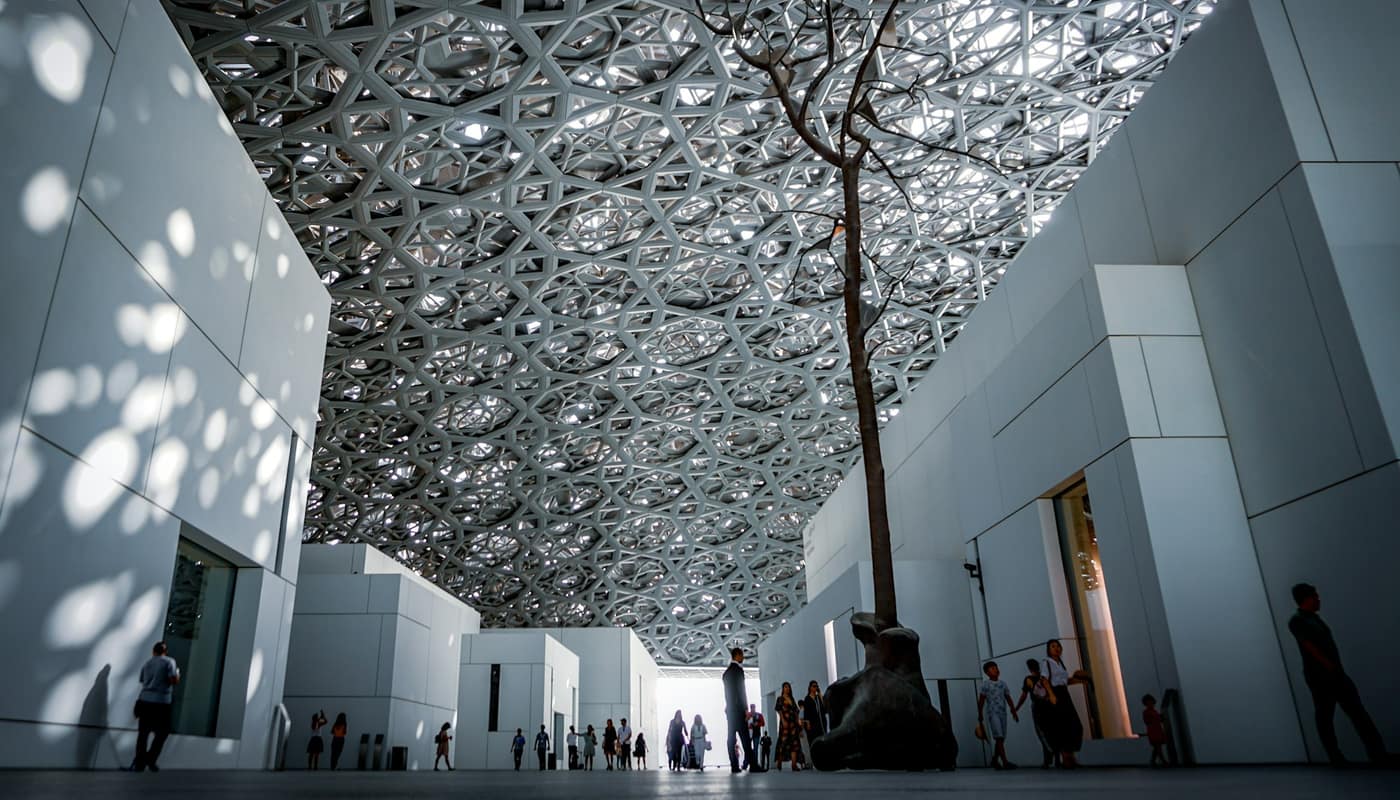
The Louvre Abu Dhabi, on Saadiyat Island, was designed by the French architect Jean Nouvel. Press accounts give 8 November 2017 as the date of its inauguration and 11 November 2017 as its opening to the public, a difference that reflects the gap between a formal ceremony and public access. Its most recognisable feature is a large perforated dome, which filters sunlight through a pattern of openings, casting moving shadows by day and appearing as a constellation of lights at night.
Other museums in the region have opened or are planned, and readers who want a current list should check the cultural authorities of each country.
Why are governments investing in museums?
Several reasons overlap.
- Economic diversification. Cultural institutions attract visitors, create skilled jobs and support related industries such as hospitality, design and events. The broader strategy appears in how Gulf economies are diversifying beyond oil.
- Education and identity. Museums can teach young people about the region’s history and its place in the world, and they present national narratives.
- Global image. A landmark building and a strong collection signal openness and ambition, and they build relationships with international institutions.
- Preserving heritage. Collecting, conserving and displaying historical objects protects them for the future.
How are they set up?
Models differ. Some museums are national institutions with collections built through purchases and donations. Others work through partnerships with established museums elsewhere. The Louvre Abu Dhabi was created under an intergovernmental agreement with France, which provided for the use of the Louvre name, loans of works from French collections and expertise in curation and management. These arrangements allowed a new institution to open with a collection of international standing, while building its own acquisitions over time.
The partnership model has attracted both praise and criticism. Supporters say it speeds up the development of professional capacity. Critics ask about the cost, the balance between borrowed and owned works and how far local voices shape the narrative. Such debates are common wherever large institutions are built through partnerships.
What do the museums collect and show?
The Doha museum focuses on Islamic art across a broad geography, including manuscripts, ceramics, metalwork, textiles and scientific instruments. The Abu Dhabi museum describes itself as a universal museum, with galleries that put objects from different civilisations next to one another, so visitors can compare themes such as trade, belief and daily life across cultures. Both also stage temporary exhibitions and run education programmes for schools.
Museums that concentrate on Islamic art connect directly to the traditions discussed in Arabic calligraphy and Islamic geometric art. Seeing a manuscript, a tile panel or a carved door in a gallery shows how the craft was practised and what it was used for.
Who built them, and under what conditions?
Large construction projects in the Gulf have relied on migrant labour, and the conditions of workers on cultural projects have been the subject of reports by human-rights organisations and journalists. Governments have introduced reforms in recent years, as explained in why expatriates make up most of the Gulf’s population, though assessments of their effect differ. Readers interested in a particular project can look at the contractor’s and the authority’s published statements and at independent reports.
How do they fit into city planning?
Museums are often located in new districts designed as cultural quarters. In Abu Dhabi, Saadiyat Island has been planned to house several cultural institutions, together with housing, hotels and a university campus. The idea is to concentrate attractions so that visitors can spend several days, and to create an environment where art and daily life meet. The planning of such districts depends on the decisions of the emirate-level authorities described in how the United Arab Emirates is governed.
What questions remain?
Several are worth asking.
- Audience. Who visits, and does the audience include residents of all backgrounds, schools and families, not only tourists?
- Collections. How much of the collection is bought, donated or loaned, and how is it chosen?
- Voice. Do exhibitions give space to local scholars, artists and communities?
- Sustainability. Can running costs, which are high for climate-controlled buildings and conservation work, be met over decades?
- Independence. How are curatorial decisions made, and what is the relationship between the museum and the state?
These questions do not have simple answers, and independent critics, art historians and visitors will weigh them differently. They are the kind of questions that all large public museums face.
What role do schools and communities play?
Museums run education programmes for school groups, workshops for families and training for young professionals who may become curators, conservators and educators. Some invite local artists to create work, and others support research into the region’s archaeology, language and art. The aim is for a museum to be a place where residents see their own history and culture reflected, not only a destination for tourists.
Building a pool of local museum professionals takes time. Many institutions began with international staff and have since set up scholarships, internships and partnerships with universities to train specialists from the region. Over the long run, the strength of the field will depend on whether this knowledge is established locally.
How do these museums compare with older institutions?
Older museums in Cairo, Damascus, Baghdad and elsewhere hold rich collections accumulated over more than a century, often with deep archaeological holdings, and they have faced funding and security challenges at different times. The newer Gulf museums are better funded and newly built, but have shorter histories of collecting. Together they form a regional network, and their curators increasingly work with the older institutions on loans, exhibitions and training, so that a visitor can follow a theme, such as Islamic art or ancient trade, across several countries.
What should visitors know?
Opening times, ticket prices and special exhibitions are published on each museum’s official site and change over time, so it is worth checking before a visit. Museums often have specific rules on photography and on bags, and many have free or discounted entry for residents or students at certain times. A visit combines easily with other cultural sites in the same city.
Sources: Louvre Abu Dhabi; Museum of Islamic Art, Doha; Phaidon; The Art Newspaper